
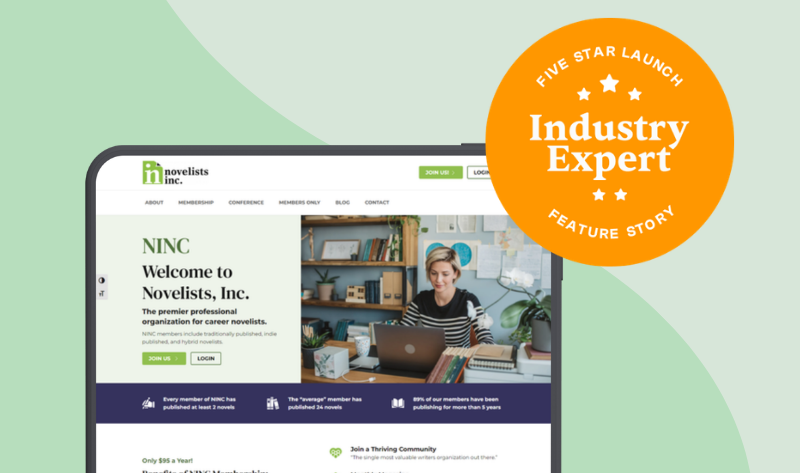
TL;DR
- NINC is a professional organization for novelists with merit-based membership requirements.
- Many authors first join for the conference, which is known for high-level education and networking.
- NINC stands out because members share a professional baseline, which leads to stronger business conversations.
- The real value is often in peer access, not just formal sessions.
- Industry contacts at NINC can help authors solve problems faster with platforms and publishing vendors.
- Current membership requires two books, each earning at least $3,000 in a 12-month period.
- NINC is expanding beyond the conference with webinars, community spaces, publishing updates, and more year-round value.
What is NINC?
NINC is a merit-based professional organization for novelists. Authors join for its respected conference, advanced networking, and career-focused community. Membership currently requires at least two books, each earning a minimum of $3,000 in a single 12-month period, making NINC especially valuable for established or growth-minded novelists who want higher-level publishing conversations.
Celeste Barclay, Booksprout’s Head of Marketing, sat down with NINC’s 2026 president, Kevin McLaughlin, to discuss how Novelist, Inc (NINC) serves the author community and how novelists can join.
Why NINC Gets Talked About So Much
Some organizations are known for their resources. Others are known for their community. NINC tends to come up in author conversations for a different reason first: aspiration.
For many novelists, NINC is something they hear about before they fully understand it. They hear about the conference. They hear that serious professionals go. They hear that the conversations are better, the space is different, and the experience feels more advanced than what they have found elsewhere. That creates a kind of magnetism around the organization.
That same pattern came through clearly in the interview with Kevin McLaughlin. His path into NINC started with the conference. He had heard it was one of the best conferences in the world for writers, and that reputation was enough to make joining feel like a goal worth pursuing.
In many ways, that is the perfect introduction to NINC: not just a professional group, but something authors actively work toward.
What NINC Is and Why It’s Different
NINC fills a very specific role in the author world.
It is a professional organization for novelists, but unlike many writing groups, it is not tied to one genre. Romance authors may have one professional lane, science fiction and fantasy authors another, but NINC works across categories. That makes it broader than genre-based organizations while still staying focused on a specific type of writer: novelists.
What really makes NINC stand out, though, is that it is merit-based.
You do not join simply because you write novels. You join because your books have already reached a defined level of commercial success. That requirement changes the dynamic of the organization in an important way. It creates a shared professional baseline.
That is part of what makes Kevin’s description so effective. NINC is not trying to be everything for everyone. It is designed for authors who are serious about building sustainable publishing careers.
Why the Membership Threshold Matters
One of the strongest points Kevin made was that NINC’s minimum requirements create a floor. Not a ceiling. A floor.
That distinction matters because it shapes the quality of conversation.
At broad writing conferences, a large percentage of attendees may be unpublished or still trying to figure out the basics. There is absolutely a place for those spaces, and they can be incredibly valuable for new authors. But once a writer moves further into a professional career, their questions change. They are no longer asking how to upload a book or whether they need an ISBN. They are thinking about scale, business models, release strategy, rights, packaging, ads, platform shifts, and sustainability.
Kevin explained it simply: the minimums create a baseline that changes the room.
“The thing that the minimums do is they create an artificial floor.”
— Kevin McLaughlin
In practice, that means members begin from a more advanced starting point. They may still be at very different revenue levels, but they are no longer having entry-level conversations. That slight shift can make a major difference in the kinds of ideas exchanged and the level at which authors are able to connect.
Why Authors Join NINC in the First Place
For many, the answer is still simple: the conference.
The NINC conference has a reputation for attracting professional novelists who want education and connection at a more elevated level. The sessions can be valuable, especially for authors interested in new business directions, hybrid publishing, or sharper strategic thinking. But the interview made something else clear too: the conference’s biggest strength may not be what happens at the front of the room.
It may be what happens around it.
Kevin emphasized that for many career authors, the most valuable learning comes from talking with peers in informal settings. Some of the best takeaways do not arrive in a keynote. They show up in side conversations, over meals, and in the candid exchanges that happen when authors compare what is working in real time.
“The odds of learning something from the conversations with your peers… is high.”
— Kevin McLaughlin
That line gets at something experienced authors already know. Information is everywhere. Context is not. Peer conversation provides nuance, practical insight, and honest discussion that is hard to replicate in a formal presentation.
The Practical Value of Industry Access
One of the most interesting parts of the interview was how grounded it was in real publishing life.
NINC is not just about inspiration. It is also about access.
At the conference, authors often have the chance to meet representatives from the platforms, vendors, and service companies they rely on. That can sound like a small perk on paper, but in practice it can be a major advantage.
Kevin made that value feel immediately concrete when he said, “If you got their business card, now you have an email.” That simple point says a lot about how publishing actually works. Problems with distribution, dashboard data, or account issues often become much easier to solve when you have a direct path to a real person.
He went even further, noting that in some cases:
“Then you can solve the problem in 72 hours instead of two weeks.”
— Kevin McLaughlin
For authors whose businesses depend on fast fixes and platform stability, that kind of access is not just convenient. It can be critical.
How to Qualify for NINC
For authors wondering whether NINC membership is within reach, the current qualification standard is clear.
At present, authors need:
- at least two books
- each book must have earned at least $3,000 in a single 12-month period

Leave a Reply