
TL;DR
- James Blatch believes most authors should think in terms of where they are in their publishing journey, not how long they’ve been writing.
- For authors with zero to three books, the priority is not ads. It’s building the platform that makes later marketing work.
- He sees email lists, blurbs, formatting, and genre clarity as foundational pieces authors need before they scale.
- He still sees podcasts and conferences as valuable because they help authors learn the language of the industry and stay current.
- James is watching AI closely, especially where it can lower costs and make publishing more accessible for authors with limited budgets.
James Blatch on What Indie Authors Should Build First
When indie authors talk about growth, the conversation often jumps straight to ads, scaling, and what platform might deliver the fastest return. James Blatch takes a more grounded view.
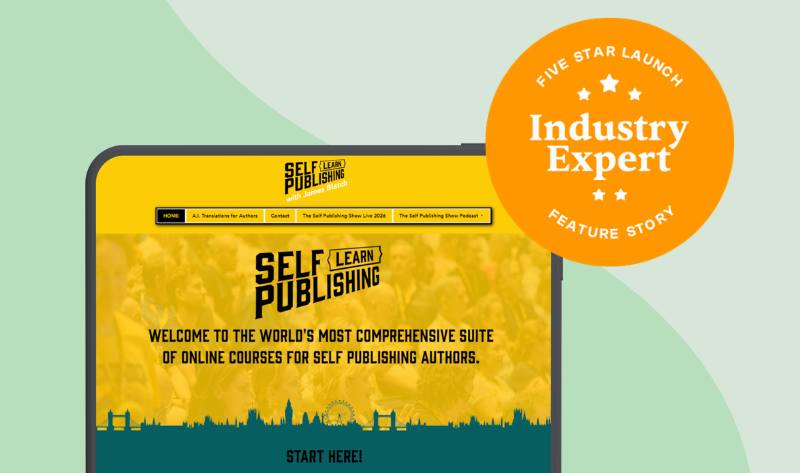
Celeste Barclay, Booksprout’s Head of Marketing, sat down with James Blatch, one of the voices behind the The Self Publishing Show podcast and head of Learn Self Publishing, the most comprehensive suite of courses for indie authors. In this interview, he keeps circling back to the same idea: authors need to build the right foundation before they try to accelerate. And in his world, that means understanding where you are in your publishing career, then choosing the tools, education, and strategy that actually match that stage.
For Blatch, the first stage is surprisingly simple to define. It is not measured by months or years. It is measured by books.
Start with the stage you’re actually in
Blatch explains that Learn Self Publishing tends to frame author growth around output rather than experience. Instead of asking how long someone has been in the business, he looks at how many books they have written and published.
That matters because it changes what advice makes sense.
For authors with zero to three books, he describes this period as the “launch pad” stage. This is where authors build the practical platform they will need as independent publishers: email lists, social platforms, formatting, blurbs, and the many pieces that experienced authors may take for granted but newer writers absolutely need to learn.
“Zero to three books is your launch pad period.”
– James Blatch
That foundation is not glamorous, but Blatch makes it clear that it is necessary. If those early pieces are weak, it becomes much harder to layer effective advertising on top of them later.
“If you get that stuff wrong, it’s quite hard to build advertising on top of it.”
– James Blatch
That is a useful reminder in a market where authors often feel pressure to race toward paid visibility before they have their product and platform fully in place.
Setting up a Booksprout account during this launch pad period helps authors prepare for their eventual book launch. The platform enables authors to get their book in front of new readers. For many authors, these are the first readers they gain.
The best time to build your platform is before launch
One of the clearest takeaways from the interview is Blatch’s answer to a question many authors ask too late: when should you start learning publishing strategy?
His answer is blunt. Before you publish your first book.
He says the launch pad stage should begin at zero, meaning while the book is still being written. That is when authors should start learning how their publishing business will function, rather than trying to absorb everything after the book is already live.
His example is especially telling. He built his mailing list before publishing his first novel and saw the payoff immediately because he already had interested readers ready on launch day.
“I started my mailing list before I published my first book.”
– James Blatch
That kind of preparation may not feel urgent while drafting, but Blatch makes a compelling case that it is far easier to grow into launch than to scramble after the fact.
Authors often wonder what to include in those early newsletters when they don’t have a book available. The writing process interests many readers, so they enjoy sharing the process with their favorite authors. It’s also where authors often find ARC readers. They share their Booksprout campaign link in their newsletter and begin gaining interest and attention.
Ads are important, but not for everyone right away
Blatch does not dismiss advertising. Far from it. But he is careful about who should prioritize it.
He describes advertising as one of the more advanced and expensive areas of author education, and he frames it as a fit for writers who are serious about making a living from publishing rather than simply wanting a polished author platform.
That distinction matters because it keeps authors from overspending too soon. Paid ads can be powerful, but only when the book package and the author’s platform are ready to support them.
He also notes that ad education has to evolve quickly, especially on Meta, where the interface and best practices can change fast enough to confuse authors who step away and return six months later.
Blatch says those courses now need updating much more frequently than they used to. That is a practical insight that most indie authors will recognize instantly: learning ads is not a one-time task. It is maintenance.
Not every platform is worth chasing
Blatch’s comments on newer ad platforms are refreshingly pragmatic.
While he is still willing to test Reddit, he is not convinced it is viable for lower-priced books yet, even if it may work for higher-ticket products like courses. He points to the economics of book sales as the core issue. A campaign structure that works for a product worth hundreds of dollars does not always translate to a book selling for a few dollars.
That is one of the interview’s strongest undercurrents: authors need to be realistic not just about trends, but about margins.
He is also clear that some platforms simply have not earned their place yet in a typical indie author strategy. The willingness to test is there. Blind optimism is not.
In a conversation full of tools and tactics, Blatch also makes a thoughtful case for something less direct: the value of publishing podcasts.
For him, podcasting is not just content marketing. It is a way of inducting authors into the language of the industry.
He talks about listening to self-publishing podcasts early on and gradually absorbing terms and concepts that initially sounded like nonsense. Over time, the jargon stopped being jargon. It became working knowledge.
“That language seeps in.”
– James Blatch
That is a smart description of how many authors actually learn. Not all at once. Not through one giant breakthrough. But by listening regularly, hearing the same ideas repeated in context, and slowly becoming fluent.
Blatch wants the podcast he co-hosts with romance author Cecelia Mecca to serve that same function. Newer authors can tune in and begin to understand the business, while more experienced authors can use it to hear what is changing next.
That dual purpose feels especially relevant in an industry moving as fast as this one.
Conferences are evolving too
Blatch also talks about the evolution of author conferences, particularly the move toward workshop-heavy formats that give attendees more flexibility and more depth.
What stands out in his comments is that he is not pretending event planning is simple or cheap. He is candid about the tradeoffs, the cost of recording sessions, and the challenge of delivering value without pricing authors out.
That honesty tracks with the rest of the interview. Again and again, he returns to the practical realities authors face: budget constraints, information overload, and the need to make smart choices about where to invest.
It is easy to romanticize author education. Blatch keeps pulling it back toward usability.
No current conversation about indie publishing stays away from AI for long, and this interview is no exception.
Blatch is clear that AI is already disrupting the industry. He knows it is controversial. He also knows pretending it will disappear is not a strategy.
What is more interesting is where he sees the real value. He is less focused on replacing authors and more interested in how AI can simplify workflows, reduce costs, and help authors spend more of their time doing the human work of writing.
He is especially interested in translation, visual assets, and the kinds of production tasks that have traditionally been expensive for indie authors to outsource well.
That leads to one of the strongest moments in the interview.
“People underestimate the democratizing nature of AI.”
– James Blatch
Blatch argues that AI can give authors from poorer backgrounds access to a stronger starting point than they might otherwise afford. In other words, the technology may not just change efficiency. It may change who gets to compete.
Whether authors agree with every part of that argument or not, it is a serious point worth considering. In a business where cash flow often shapes opportunity, tools that lower the barrier to entry can have real consequences.
The bigger takeaway: build smart before you scale
What makes Blatch’s perspective useful is that it is not built on hype. He is not telling authors to ignore craft, nor is he pitching a silver bullet.
Instead, he keeps returning to sequence.
Learn the basics before you rush to advanced tactics. Build your platform before you expect ads to save you. Use podcasts and conferences to stay fluent in the business. Test new tools, but do not confuse novelty with necessity. And pay attention to technologies that may make publishing more accessible, not just more complicated.
That kind of thinking is especially valuable for authors who feel pulled in ten directions at once.
Because underneath everything else, Blatch’s advice comes down to this: success in indie publishing is not just about doing more. It is about doing the right things in the right order.

Leave a Reply